Air-cooled and hybrid liquid-cooled GPU racks routinely move 2,500 to 5,000 CFM of air per cabinet. Even when chilled cold-aisle supply is adequate, restrictive door perforations, unsealed empty rack units, and open roof cable holes create hot-exhaust recirculation that elevates top-of-rack GPU inlet temperatures by 6–12 °C.
Built to EIA-310-E dimensional and static-load engineering standards; structural load test documentation available per project. Explore our parent 42U Heavy-Duty High-Load Racks hub or review the R42-8120 flagship datasheet.
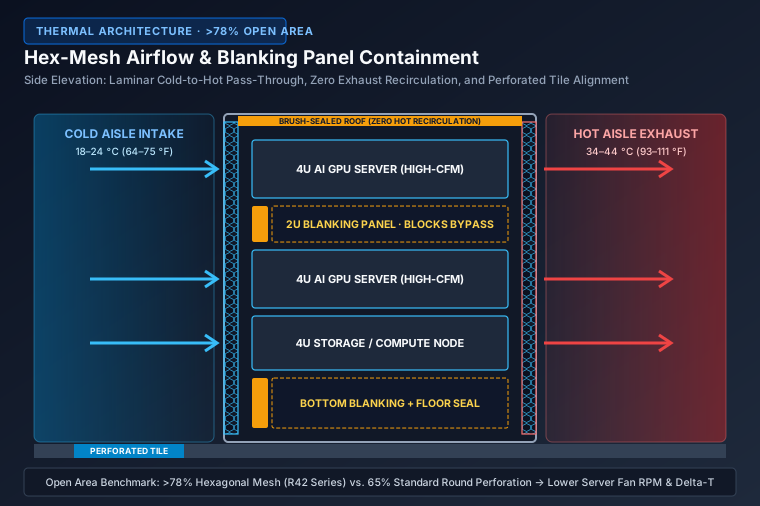
Why >78% Hexagonal Perforation Beats Standard 65% Round Mesh
Door perforation percentage governs static-pressure drop across the front and rear cabinet boundaries. Because fan power increases roughly with the cube of rotational speed (fan affinity laws), cutting intake resistance directly lowers server fan energy draw and thermal throttling risk.
| Door Ventilation Class | Free Open Area | Thermal Behavior at 20–35 kW / Rack | Structural Rigidity |
|---|---|---|---|
| Legacy Round-Hole Door | 60 – 65% | Elevated front-door ΔP; drives server fans higher | Moderate steel web between holes |
| Enterprise Benchmark Door | 75 – 77% | Good laminar intake for 15–25 kW enterprise rows | Reinforced vertical stile frame |
| R42 Series Hexagonal Mesh | > 78% open area | Minimal ΔP for 25–40 kW GPU fan walls | Honeycomb web retains high shear stiffness in 1.5 mm steel |
Four Mandatory Airflow Sealing Steps Inside Every 42U Cabinet
High-perforation doors alone cannot prevent thermal bypass if internal air paths leak from the hot rear plenum back to the cold front intake:
- Install Blanking Panels Across Every Open U: Never leave 1U to 6U gaps between servers unsealed. Snap-in steel or flame-retardant ABS blanking panels block hot rear exhaust from short-circuiting directly into the intake of the server above.
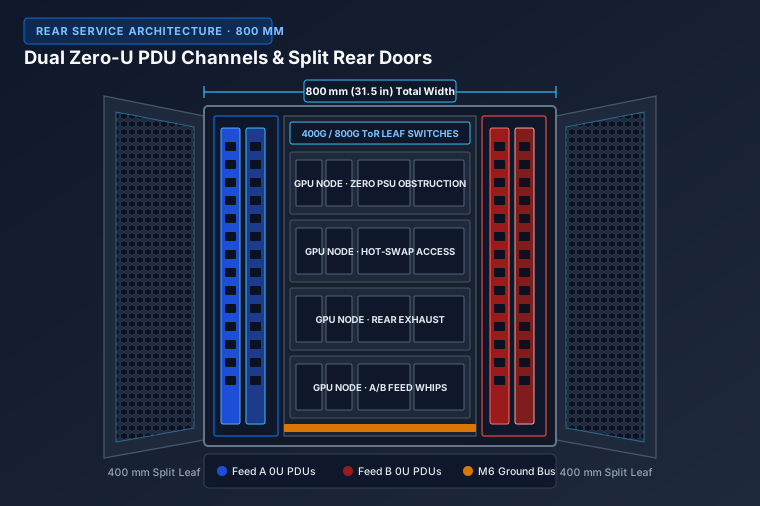
- Seal 800 mm Side-to-Rail Gaps: On 800 mm wide racks (R42-8120 and R42-8120-HD), factory-installed vertical air-dam brush seals between the 19-inch mounting rails and outer frame columns stop rear exhaust from looping forward around vertical cable bundles.
- Use Brush Grommets at Every Roof & Floor Penetration: Unsealed rectangular top cable cutouts bleed hot exhaust over the cabinet roof straight back into the cold aisle. Brush-sealed roof ports let 3-phase PDU whips and MPO fiber trunks pass while maintaining an air barrier.
- Close the Under-Rack Base Gap: On slab or raised-floor halls, fit a front base air-dam baffle (or solid bottom panel on slab floors) so hot aisle air cannot creep underneath leveling feet into the cold-aisle intake.
Raised-Floor vs. Slab-Floor Containment Alignment
- Raised-Floor Halls: Align 600 mm wide R42-6110 rows directly over high-flow perforated tiles (1,200 mm cold aisle width) and install floor grommets under every cable drop so under-floor static pressure stays uniform down the row.
- Slab-Floor Halls with Cold Aisle Containment (CAC): Standardize every cabinet in the pod to identical 2,000 mm (78.7 in) exterior height so containment roof panels and end-of-aisle sliding doors seal cleanly along the full row.
Need blanking panel kits, side air-dam baffles, or custom brush roof cutouts quoted with your racks? Send your thermal density and rack count on our 15-Minute Formal Quote page.
Standard & Custom-Engineered Models
42U 800×1200 mm 2,000 kg Heavy-Load Server Rack
Reinforced 800×1200 mm 42U welded frame engineered for 2,000 kg (4,409 lb) static loads, liquid-cooling manifolds, and seismic-ready anchoring.
Full Datasheet →